
Believe In Better
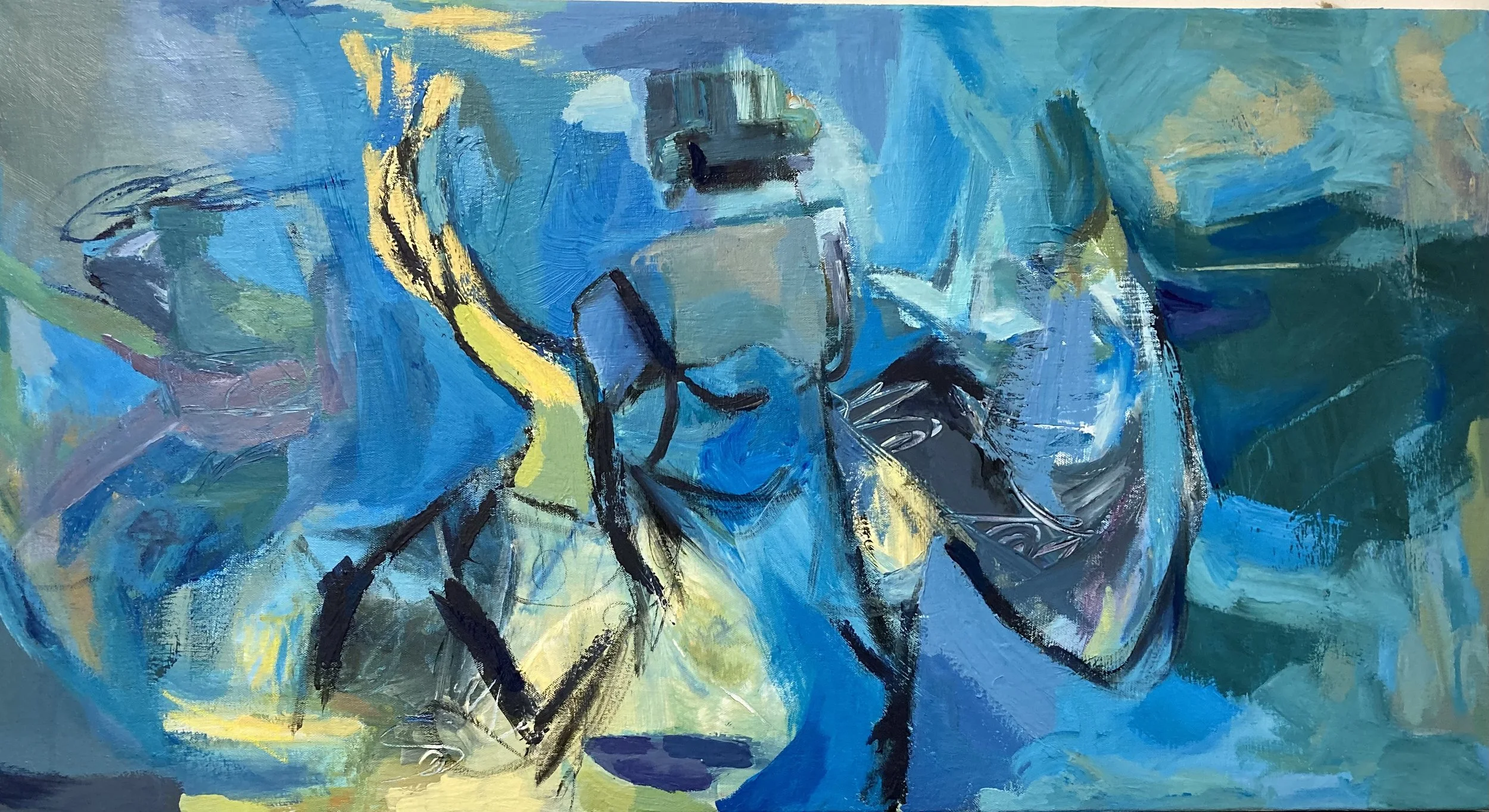
acrylic on canvas
24” X 36”
It's been a hard year, a hard life, yet there is so much to believe in, that better days are coming, that people are rising up, banding together. There must always be that hope, that connection, that remembrance.
This was made as a commissioned piece for a Jewish couple in early 2024, months after Oct7, who just had a baby and bought their first house.
Here’s what I wrote about it for them:
I was working with the feeling of hope. I wanted, above all, for you to feel relief and light and hope when you looked at it, in your new house and with your new baby. As we all know, it’s been a very hard year, and I wanted the painting to hold the hope breaking through and overtaking any challenge. Before I start painting, I scrawled “hope” across it. I worked with an image of a person wearing tefillin with their arms raised in a prayer for hope. In the piece you can see the abstracted tefillin on his head. The feeling of connection and groundedness to the physical and the spiritual is part of it. On the side, if you turn it, is an abstracted figure with their heads in the their hands.
Dec 12, 2023
If anyone else feels a weight this Hanukkah, a brewing sadness, bursts of despair, frustration at God… you are not alone.
Sometimes the happier times seem to bring a structure necessary for my sadness to rest. Sometimes it is in the company of others that my sorrow feels safe to come out and speak.
It comes suddenly, when I least expect it, a dark sadness that doesn’t seem to be related to anything. Nothing to be concerned about, no direct thought or image popping up. Just a weight in my body, a drooping in my eyes.
We are still in mourning. How, so many emails I have coming in ask, how do we celebrate right now? Where do we find the light?
I started taking a painting class, for the first time in… probably about 6 years or so. And it’s been amazing, absolutely fantastic. Core learning that I need.
The class is in a nearby town, and walking in with my headscarf I feel… very much like a lady with a headscarf. But everyone is cordial, kind enough.
Today I showed the teacher, a slightly grumpy, fairly expressionless man in his forties, a few pictures to ask for suggestions on which one to choose for my upcoming painting.
"I wouldn't choose an iconic image," he says, after looking at the three, “like this one, the Kotel" he continues by way of explanation, gesturing to one of my photos.
The word Kotel hangs in the air between us, a silent clanging of bells, a noise only I can hear, while the rest of the painting crew carries on obliviously around us.
He said the Kotel instead of the Englishized version Western Wall,indicating he was almost certainly in the know, a Jew with a Jewish upbringing.
I don't say anything at the time, I store it in my brain, the bells gradually subside and stop clanging, and I go back to work.
Three hours later, we're cleaning up, he's shlepping things from the class to his car, I'm piling my paints back in my bucket.
I stop him in the doorway. "You Jewish?" I ask, "because you called it a Kotel."
"Yeah," he says. "amazing trip there in ‘95. With Young Judea. We went to Eilat and up and down the southern kibbutzes. They were my favorite part.” He pauses and looks at me. “I loved those southern towns so much."
I look at him sadly and nod, a thousand silent words pass between us, and then we walk away from each other and that is that.
Later, I reflect on the conversation and I realize that anyone surrounding us might not have picked up on what wasn't said.
He never used the words October 7th or war. I don't even think he said the word "Israel". All he said, with a slight hint of sadness in his voice, was that he loved the southern towns, the kibbutzes. And what I heard and felt was the rape and abduction and mass murder that happened there.
Perhaps the fact that such a lengthy silent conversation could pass between two Jews who barely know each other was the most devastating of all.
I went into my car afterwards and I cried. I cried for how much could be said by saying so little. I cried with the comfort of the light around me.
I light the candles these days and I wonder: God, where are You? Where were You?
The brighter the lights, the more devastating it all is.
It is utterly, utterly devastating.
And maybe that's what I'm supposed to feel this Hanukkah. That I am surrounded by all of these people I love so much, that we are healthy and happy, that life is in so many ways good, and it is still utterly not enough. We are still utterly broken. And somehow, don't ask me how, I find that comforting in its own way this Hanukkah. It could be nothing else.
I have felt on and off since October 7 like Tevye in Fiddler on the Roof, after the Russian soldiers rampage his precious daughter’s wedding, and everything shifts from a sensational high to utter shock and destruction. And when the horses and soldiers finally leave, and it's just Tevye and his family alone, surrounded by the chaos of their newly torn apart lives, Teyve finally breaks the silence. "Well,” he says, exasperated, “what are you waiting for? Let's clean up." And they all slowly stoop down and start picking up all the shattered pieces.
We can't pretend that the world isn't shattered right now. I can't. I can focus on the light and fill myself with gratitude, but the utter destruction is still lying beneath all of that goodness. The world is still ravaging. The destruction and deaths are still mounting. We are all still crying. We are all looking wordlessly around, at the chaos of our newly torn apart lives, and wondering how to put it back together.
All I can say is,
"God, we're still here and we're waiting for you. We need you. Please come back. Please help us heal this world before it's too late. Please help us before all the light has run out."
——
December 28, 2023
I’ve been thinking of many things in the last few weeks since posting, vignettes of life that don’t seem to leave my head, that are whispering to me to share them, though I have nothing beautiful to wrap them up with, no delicate thread to weave together .
I’ve been thinking about the question of what to tell the children.
What can the children bear.
Before October 7, I used to think that shielding my kids from the horrors of the world was important; that to hear the brutal terror of the world that exists outside of their four cubits couldn’t do anything except hurt them, affect their nervous system for no reason, make them feel vaguely unsafe without understanding why.
I have to say, along with many things, I have laid down my convictions, sunken down to the sidewalk, and I just sit there, hunched over, in many ways absolutely uncertain of what is best for the children (other than the staples- the joy, the ability to run around screaming with their friends (has anyone else been positively moved by the sheer amount of joy that kids get from just running around aimlessly amuck with their friends and shrieking? Put away those screens, fellas, kids just wanna yell)).
When I was 16, newly licensed, I pulled into the garage of my childhood home, but at the last second, my mind froze and I could not remember for the life of me which pedal was the brake and which was the gas. So I slammed on it. The gas that is. And the car shot forward and ricocheted off of the wall, but not before making a sizable dent in the wall it shared with the dining room. I had driven through the dining room wall.
The side of that wall had an older German china cabinet from the 1930’s belonging to my immigrant grandparents on it, full of china. But luckily it fell onto a cushioned dining room chair, and nothing broke.
Still, I vividly remember my dad walking in the door that day, seeing the hole in the dining room wall, the German cabinet slanted, almost toppled over. And him just wordlessly sinking down to the floor, bearing witness.
The image of the sinking down has stuck with me. Sometimes there really are no words.
A nonJewish friend from Long Beach came up with her kids to visit a month after October 7. She had been one of the first to text me after the attacks, and we exchanged pleasantries for a long time, until she cornered me in the kitchen while the kids were playing. In a low voice, she shared, “I didn’t want to say anything in front of the kids about Israel, but how are all are you doing?”
I appreciated the sentiment and the care, but in the back of my mind, all I could think was, Lady, my kids are walking down the streets every day lined with messages about the kidnapped. This isn’t something we are privileged to talk about behind closed doors.
What to tell the children. What can children bear.
I took the kids to the Hanukkah concert a block away; the streets are closed, a few hundred mainly Orthodox Jews come out, and musicians perform.
The headliner, an Israeli Jew, takes a breather from his cheerful, soulful renditions to share some words with the crowd. “Friends,” he says, as teenage boys goof off in the front row, “I want to take a few moments to honor all those we have lost. In particular,” he continues, “ I want to honor my cousin and his whole family, who did not survive, who were burned alive in their home in the south of Israel on October 7.”
I am standing with my kids who are silently bearing witness as the man is sharing about how his cousin and family was burned alive in their home.
Because sometimes one doesn’t have the privilege of whispering about such horror behind closed doors. Sometimes the terror needs to be known in the streets.
And my seven year old turns to me, her face scrunched up in a state of deep pain.
“Mommy,” she says, her eyes searching mine. “Can I have some cotton candy? Pleeaaaase?”
This girl was much, much, much more stressed out about not getting cotton candy that night than anything else she heard. Never heard her ask any questions about people being burned alive since that night, not once.
What is it that terrifies children, that keeps them up at night, when the world is on fire somewhere farther away? For my seven year old, it is the potential monster that might somehow come out when she flushes the toilet, the realization that we will all die and that she will be separated from us, the mentally ill on the streets yelling at us as we pass, and for all my kids- the impending climate crisis, for which they cannot, for the life of them, understand why grown ups aren’t taking more seriously.
But the news.. the news from farther away, I just don’t know. I don’t know anymore. I don’t know how much is important for them to know, if it’s helpful to hear about how much worse others have it. If it’s okay for them to know that some people hate Jews. And not just in the story and history books, but today. I don’t know what will strengthen their resiliency. I don’t know what I’m supposed to shield my children from, though I certainly don’t want to spend my breath filling the home with fear of what could happen.
A few weeks ago, at my twelve year old’s basketball playoff, one of her teammates slipped on the floor and twisted her ankle something awful. And as fell to the floor, she instantly exploded into loud shrieks of pain. “It’s broken!” She screamed, sobbing wildly.
And the entire room of parents, siblings, and teammates just stopped. This great pain of this child, the tenderness of the human body, its ability to break and cause such suffering, sucked all the attention from the room.
I couldn’t look away, or talk, or waste away the time checking my phone. The entire room stood at attention, unable to bear the noise of a child in utter pain and despair, unable to look away until that pain was soothed. As if watching and holding the space could make it better. A scorekeeper and a parent who was also a medic knelt beside her, attending to her. Children ran to get ice. Finally, they lifted her up, she put her arms around both of them, and she hobbled away, out the door, to go to the hospital. The room broke into grateful applause, and could finally resume watching the rest of the kids finish their game.
The immense, excruciating pain of just one person in distress. To be witness to it is truly unbearable.
The last times that I saw the numbers, I read that 8,000 children in Gaza were just killed in the recent war. 8000. How many basketball courts full of excruciating, unbearable, stand-at-attention-there-is-nothing-else pain. It is simply unfathomable.
I’ve returned many times since October 7 to the place of my healing, Culver City Stairs, to scale it, to take in the peaceful nature, the great expanse of the LA skyline, the puffs and in-your-face music of fellow climbers. To remember how far I’ve come since I first started climbing it, when I could barely function otherwise.
Yet I cannot ignore the torn down Kidnapped signs now, just the edges still readable, a baby’s head sometimes poking out, as I approach the hill, sullying its charm, not letting me fully forget the horror of the world and my uncomfortable place in it.
The other day, I approached, and posted on top of all of the torn down Kidnapped signs was an eerily identical sign, red colors and everything. Same exact formatting. Missing, it said, and on it was a picture of a dog. $5000 reward.
As I scaled the hill, I saw the woman owner herself, shouting the dog’s name, desperately combing the hill for her precious pet.
The amount of suffering, of desperation, for this one animal. The amount we will pay to get who we love back. The signs that are torn down and the signs that are allowed to stay. Missing Dog, it said. $5000 reward.
I kept climbing the hill.
What is there to say? What do we tell the children? How do we keep on walking through this rubble?
I wish I had some greater lesson or take away or action, but sometimes these days, I just need to just sink down, wordless, without any answers, and hold that painful space.
But there is so much joy to be had in this life for me, as well, that I am focusing on. Because that is the only way forward, for me, to keep building.
May we experience a great healing. May the children be part of that healing, and may they keep teaching us. May we keep on coming together, to take care of all the children, us adults in charge of leading the way, of sowing the seeds, somehow. May we be guided in the best way to take care of the children.